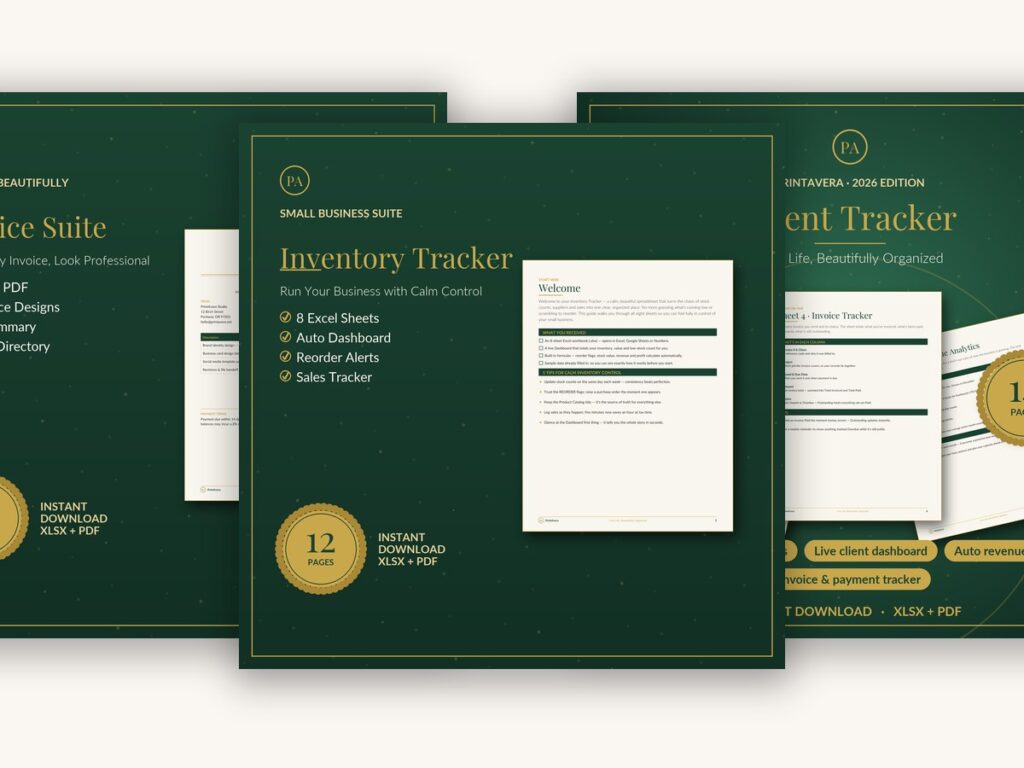
PrintAvera Collection
Run Your Business With Calm, Beautiful Spreadsheets
Invoices, inventory, clients, mileage and your investment portfolio – all organised in premium spreadsheets built for freelancers and small-business owners. Spend less time wrestling with admin and more time doing the work you love.
Running your own small business or freelance practice means you are the founder, the talent, and the entire back office all at once. The admin side, invoicing, chasing payments, tracking stock, logging miles, separating personal money from business money, rarely feels like the part you signed up for. Yet it is exactly what keeps the lights on, the tax season calm, and your creative work sustainable instead of stressful.
The reassuring truth is that financial admin does not have to be overwhelming, expensive, or built on software you need a course to understand. With a few simple systems and the habit of recording things as they happen rather than in a frantic catch-up, you can spend far less energy worrying about money and far more on the work you actually love. Most of the chaos comes from doing admin in panicked bursts, not from the admin itself.
This guide walks through the systems that matter most for a one-person or small operation: invoicing in a way that gets you paid faster, keeping inventory and client records under control, separating your business finances cleanly, handling mileage and deductions, and building a light bookkeeping rhythm you can keep up for years. None of it requires an accounting background. It just requires a place to put things and a steady habit of putting them there.
A Peek Inside
See the Quality for Yourself
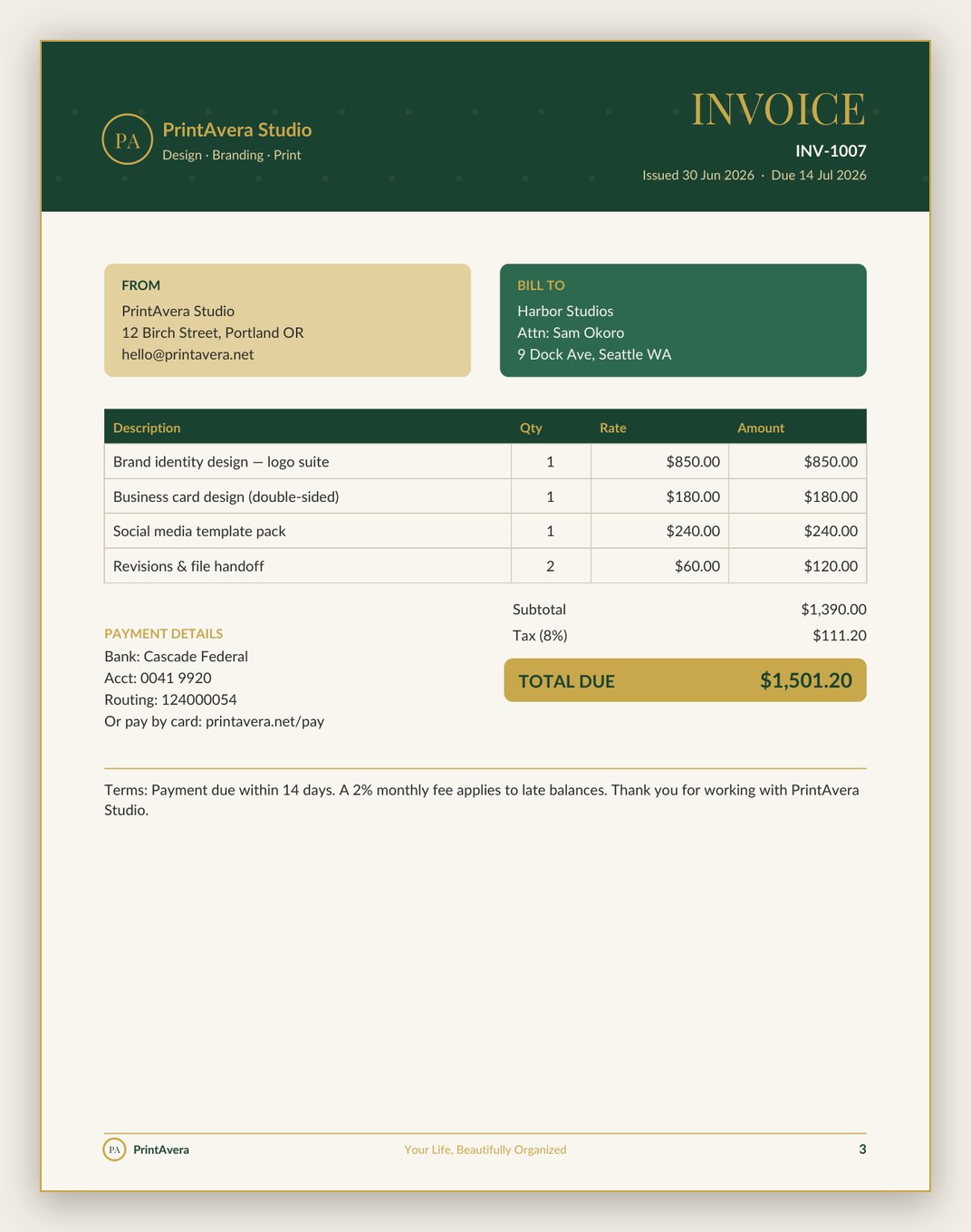
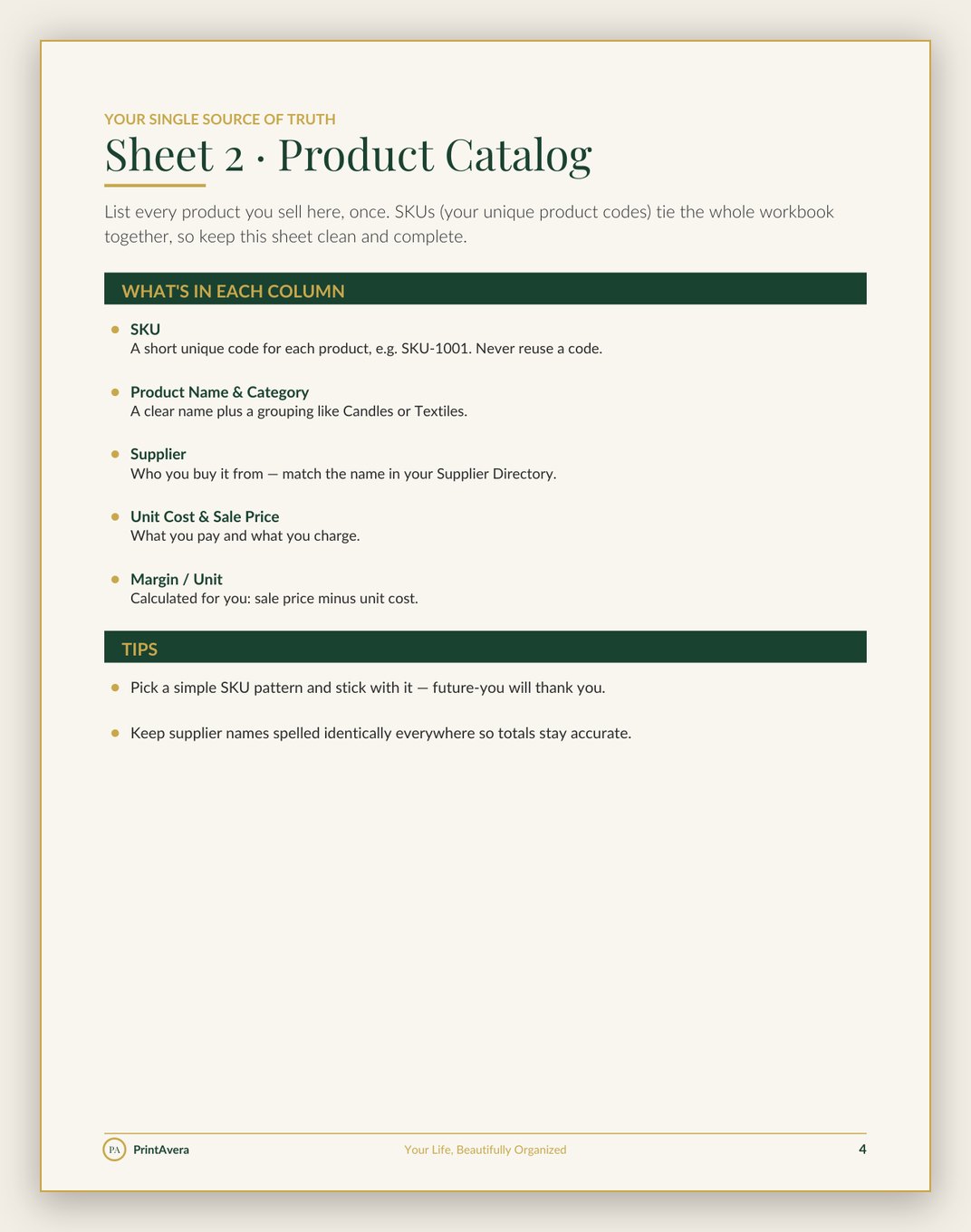
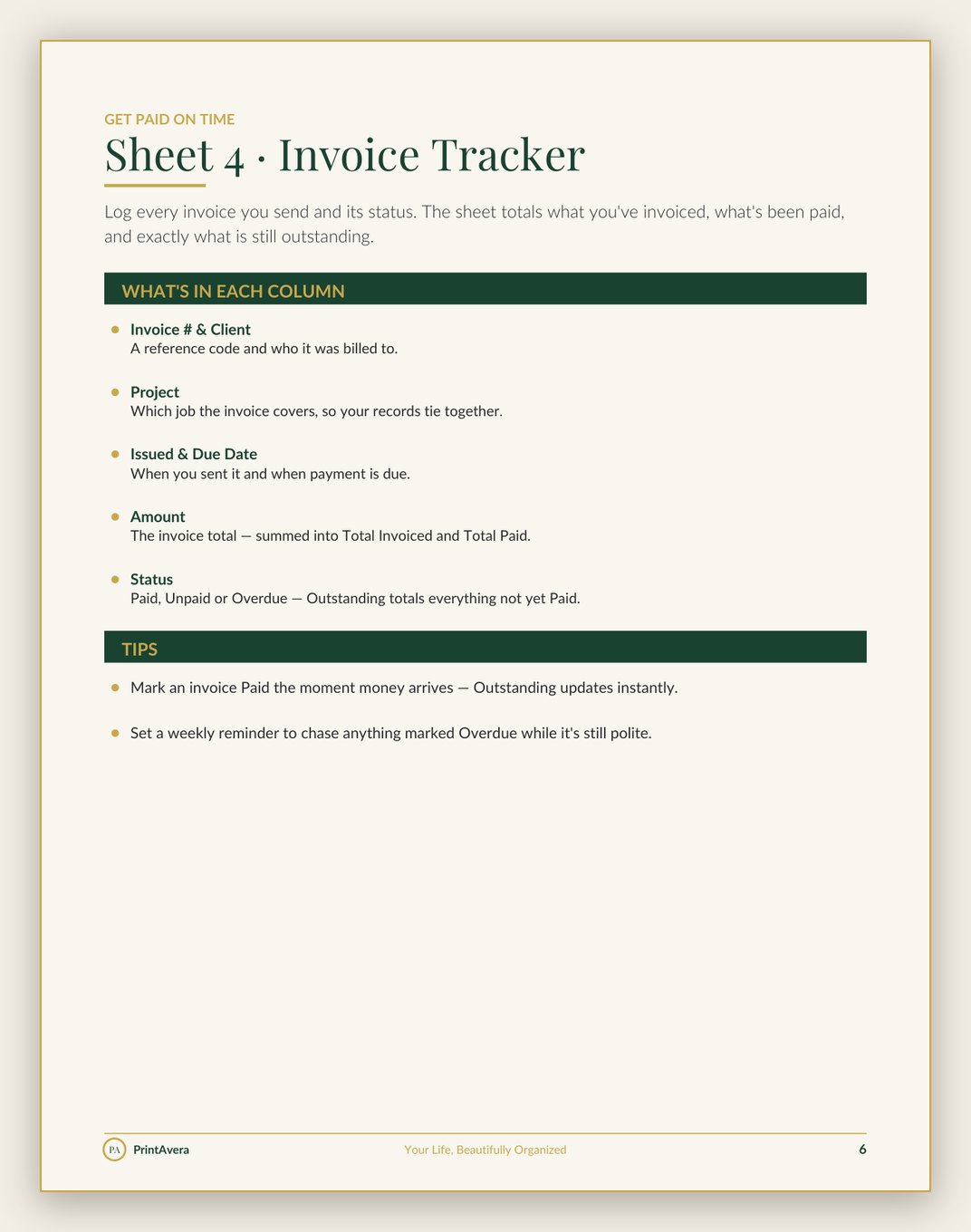
Real pages from this collection — every spread designed in our signature forest-green and gold style. See them all on Etsy →
Shop the Collection
Business Finance & Admin

Invoice Tracker Template
Send beautiful invoices and always know who owes you what – a smart Excel tracker plus three premium printable invoice designs.
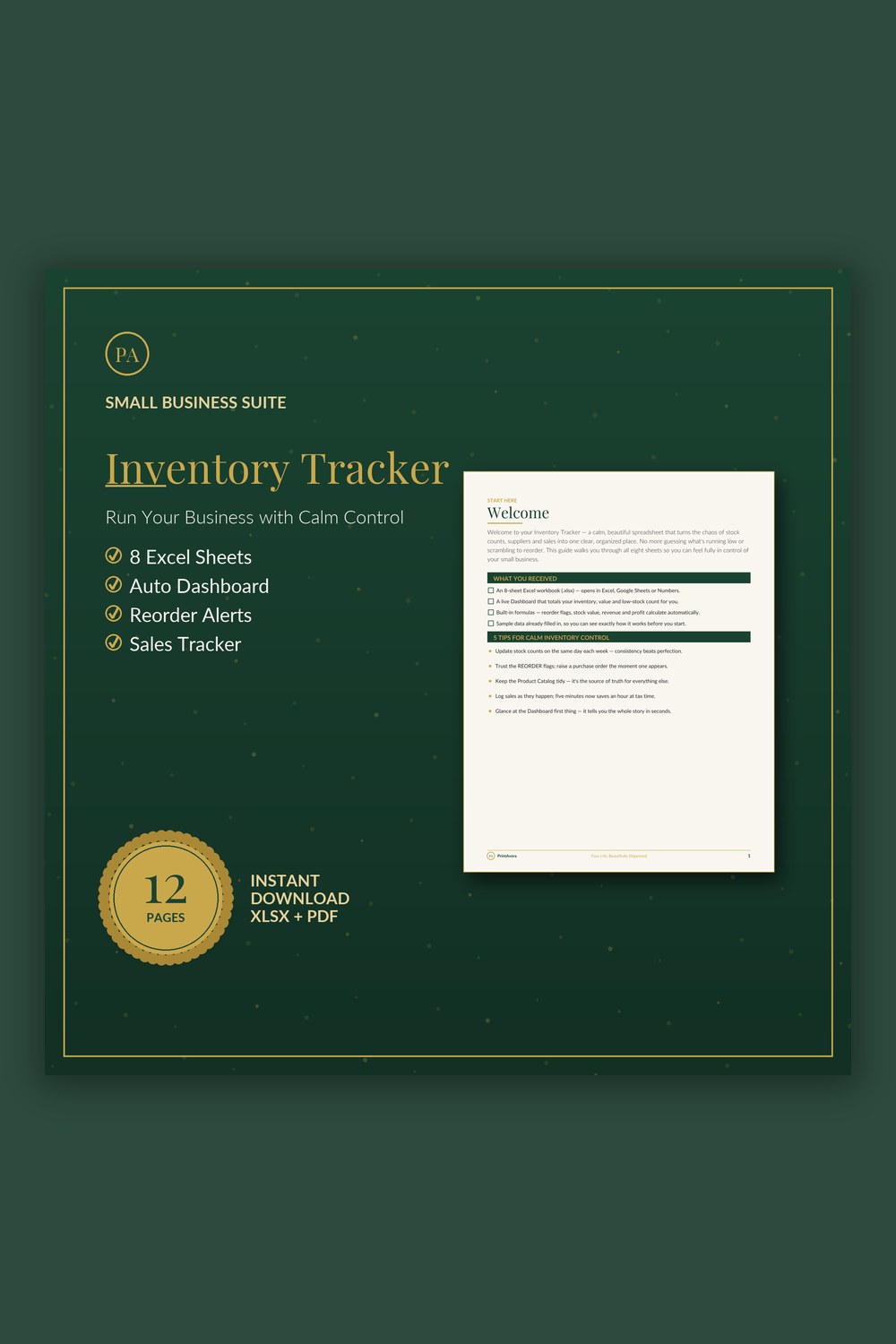
Inventory Tracker Spreadsheet
An 8-sheet inventory tracker that turns stock counts, suppliers and sales into one calm, organized dashboard – with automatic reorder flags so you never run out.
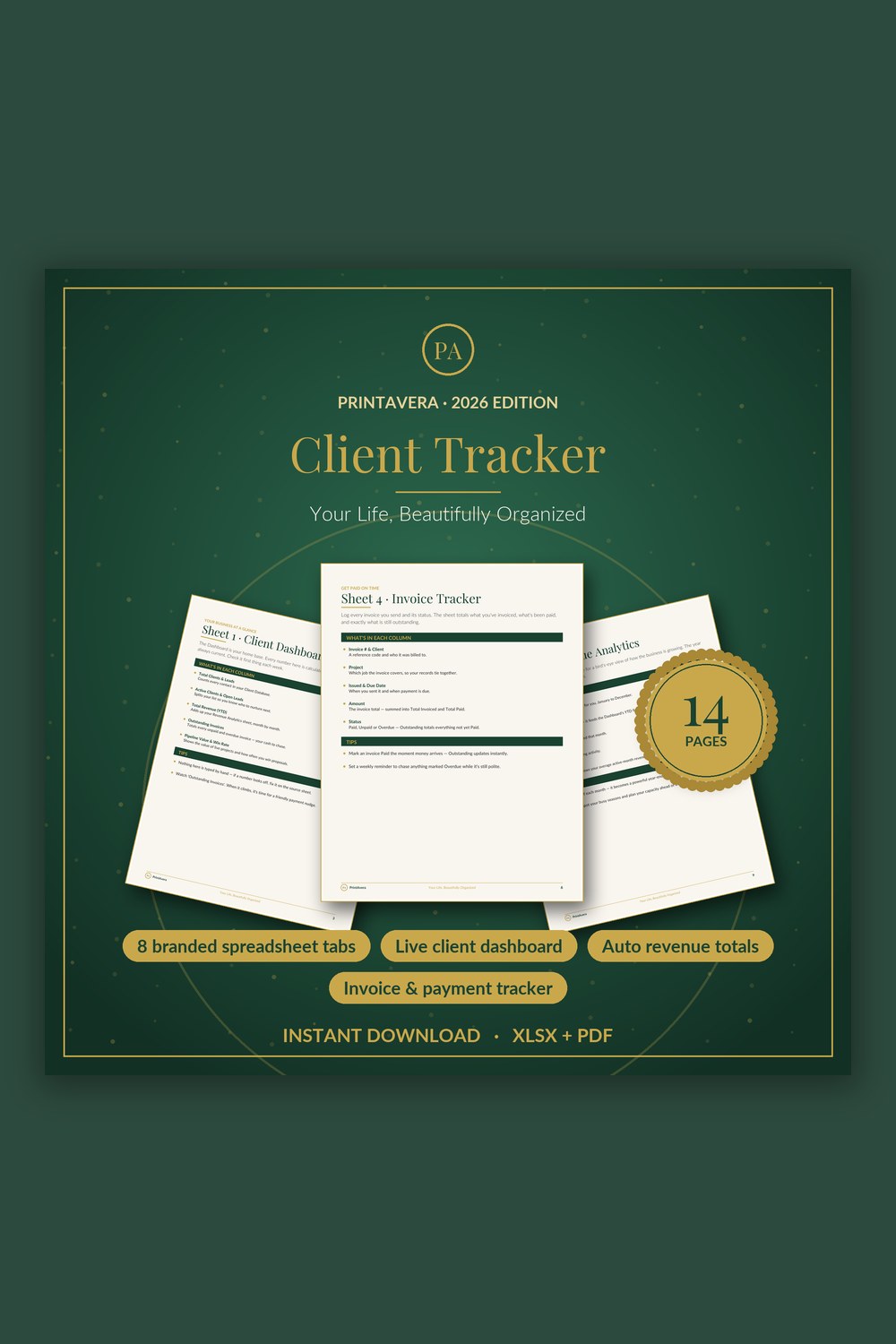
Client Tracker Spreadsheet
Run your whole client business from one calm, beautiful spreadsheet that totals your clients, revenue and unpaid invoices automatically.
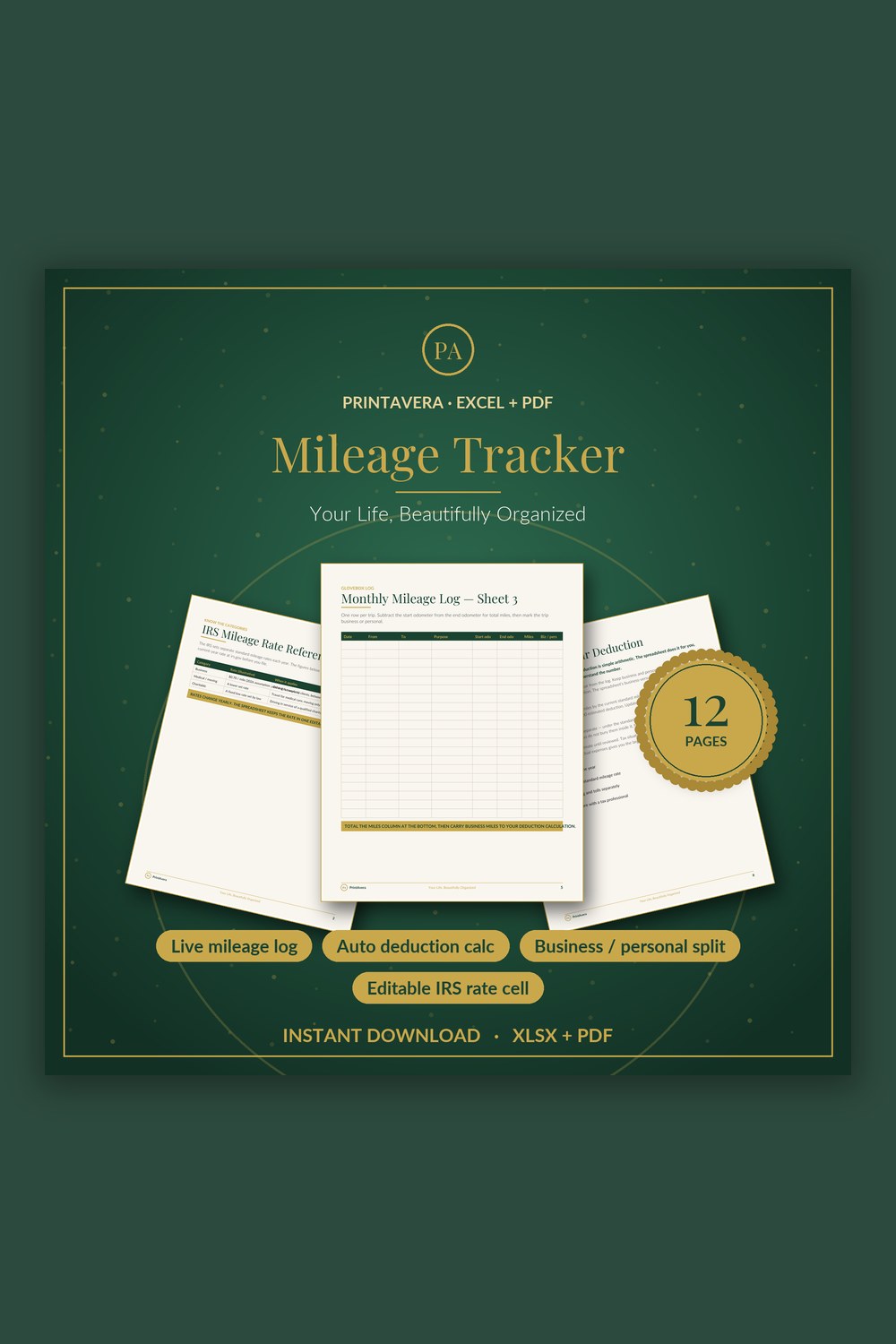
Mileage Tracker Template
Log every business mile and watch your tax deduction add up automatically — a live Excel mileage tracker plus a printable glovebox log that turns scribbled trips into a clean, IRS-ready record.
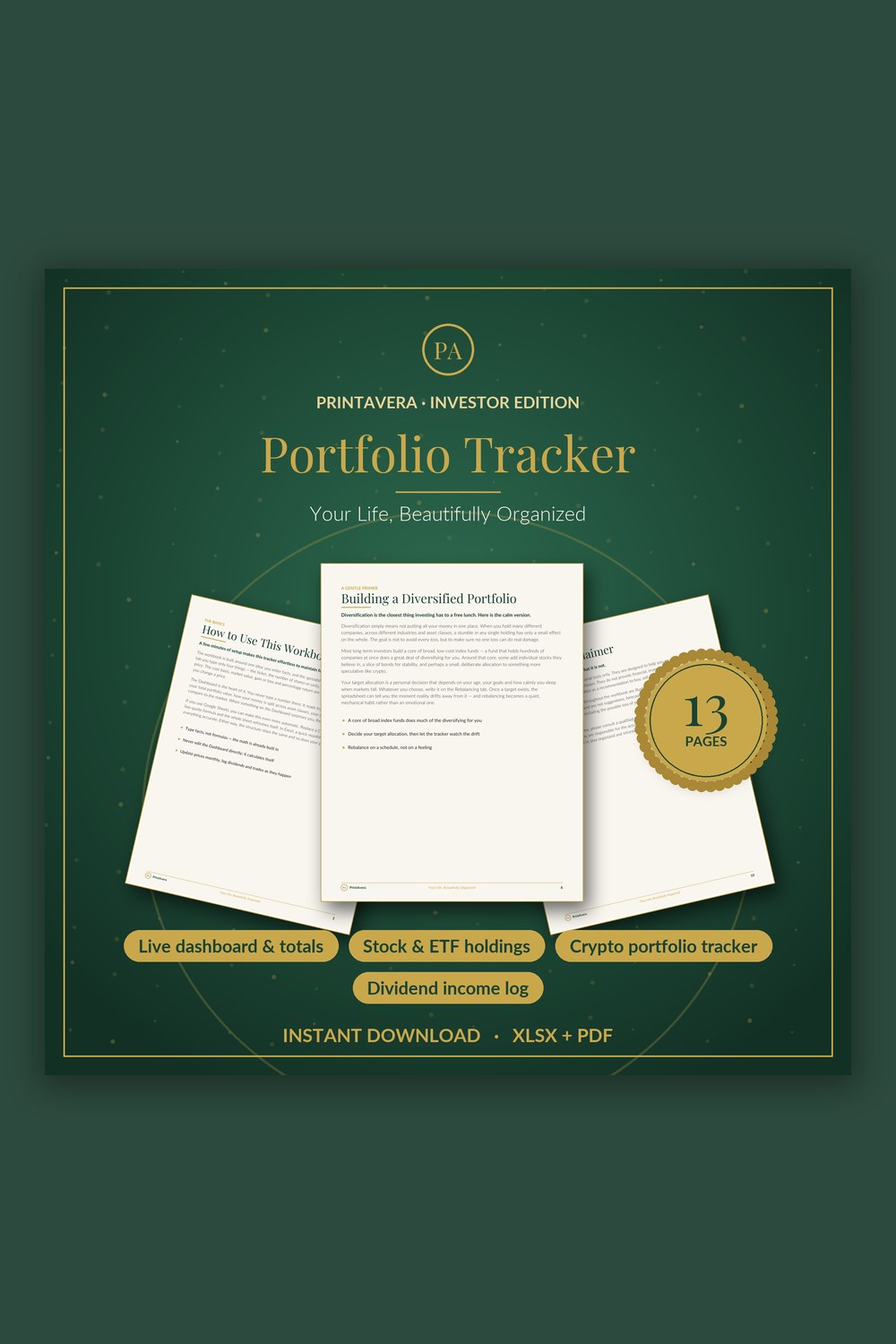
Portfolio Tracker Spreadsheet
One calm, beautifully organized workbook for every holding you own — stocks, ETFs, crypto and dividends flow into a live dashboard that shows your true value, returns and allocation at a glance.
The Complete Guide
Invoice Clearly and Get Paid Faster
Late payments are one of the most common and most draining frustrations for solo business owners, and a surprising amount of the problem traces back to vague, slow, or inconsistent invoicing. The fix is rarely about being more forceful. It is about clarity and rhythm: send the invoice promptly while the work is fresh, state your payment terms in plain language, and make it genuinely easy for the client to pay you.
A specific due date gets paid faster than a vague one.
Small details quietly speed up payment. A clear due date outperforms a fuzzy phrase like due on receipt, because a specific date gives the client a deadline their brain can act on. Offering an easy payment method, breaking large projects into milestone invoices, and numbering every invoice so both sides can reference it all reduce the friction that lets payments drift. Shorter terms, such as seven or fourteen days, often get paid sooner than the traditional thirty simply because the work is still top of mind.
The other half of getting paid is knowing, at a glance, who still owes you. When you can see what you have sent, what has been paid, and what is overdue, a follow-up stops feeling awkward and becomes a routine part of running the business. An invoice tracker template gives you that single clear view of your outstanding income, so you chase the right clients at the right moment instead of either nagging too soon or forgetting entirely until cash is tight.
- Number every invoice and include a specific due date, not just due on receipt
- State accepted payment methods and terms clearly up front
- Invoice promptly and consider shorter terms to keep the work fresh
- Send a friendly reminder a few days before and again after the due date
- Record paid, pending, and overdue invoices in one place you check weekly
Keep Inventory and Client Records Under Control
If you sell physical products, knowing exactly what you have in stock protects you on both sides: you avoid disappointing a customer with a sold-out item, and you avoid tying up precious cash in products that are not moving. Good inventory management is not about elaborate software. It is about recording quantities, costs, and a sensible reorder point for each item, so a quick check replaces guesswork before you restock or launch a sale.
Your repeat business should not depend on your memory.
The most useful numbers to track are the quantity on hand, what each unit cost you, and the level at which you should reorder, plus a note of which items sell slowly. That last detail matters more than people expect, because slow movers quietly absorb cash and shelf space that a faster seller could use. An inventory tracker spreadsheet keeps these figures in one place and lets you spot, in seconds, what to reorder, what to discount, and what to stop carrying altogether.
Your clients deserve the same organized care as your stock, and frankly your business depends on it more. Keeping notes on who they are, what you have delivered, when you last spoke, and what they might need next helps you serve them beautifully and spot natural opportunities to work together again. A client tracker spreadsheet keeps contact details, project history, and follow-up dates in one tidy view, so relationships do not slip through the cracks as you get busier, and your best repeat work does not depend on memory alone.
- Track quantity on hand, unit cost, and a reorder level for every item
- Flag slow movers so you can discount before they tie up cash and space
- Record client contact details, project history, and follow-up dates
- Note what each client might need next to spark natural repeat work
- Review both regularly so your records always match reality
Reader Favourite
Invoice Tracker Template
Send beautiful invoices and always know who owes you what – a smart Excel tracker plus three premium printable invoice designs.
Separate Your Business and Personal Money
One of the kindest things you can do for your future self is to keep your business money and your personal money in clearly separate places. When everything flows through one account, every tax season becomes a forensic investigation, untangling which coffee was a client meeting and which was just Tuesday. A dedicated business account, even a simple one, draws a clean line that makes bookkeeping, deductions, and decision-making dramatically easier.
A separate account turns tax season from a panic into a formality.
With separate accounts, your business income and expenses tell an honest, readable story without any detective work. You can see your true profit instead of a blurry mix, set aside money for taxes before you accidentally spend it, and pay yourself deliberately rather than dipping in and out at random. Paying yourself a regular, intentional amount, sometimes called an owner's draw, also helps you understand whether the business is genuinely supporting you or quietly running on your personal savings.
If you have been mixing funds, you do not need a dramatic overhaul. Open a separate account, route new business income and expenses through it from today, and let the old tangle simply close out over time. From there, a clear rule of thumb, business money in the business account, a set percentage moved aside for taxes, and a regular draw to yourself, keeps everything clean going forward and turns tax season from a panic into a formality.
- Open a dedicated business account to draw a clean line from personal money
- Route all business income and expenses through it from today onward
- Set aside a percentage of income for taxes before you can spend it
- Pay yourself a regular, intentional draw rather than dipping in at random
Log Mileage and Track Deductions for a Calmer Tax Season
If you drive for work, those miles can add up to a meaningful deduction, but only if you have records to back them up. The key word is contemporaneous: log each business trip with the date, destination, purpose, and distance as you go, because reconstructing a year of driving from memory in April is stressful, error-prone, and far weaker if anyone ever asks you to support it. A few seconds after each trip beats hours of guessing later.
When it comes time to calculate the deduction, do not rely on a number you remember from a previous year. Check the current-year IRS standard mileage rate, because it is adjusted periodically and using an outdated figure can quietly cost you or overstate your claim. Keep your business and personal driving clearly separated in your records, since only the business miles count, and hold on to the log itself rather than just the final total.
Mileage is only one of the deductions that slip away when records are messy. Supplies, software, a portion of home-office costs, professional services, and equipment can all matter, and the habit that captures them is the same: record it when it happens. A mileage tracker template keeps your travel records ready and audit-friendly, while a portfolio tracker spreadsheet gives you a clear view of any longer-term business savings or investments, so your full financial picture, the everyday and the long-game, stays in one calm, organized place instead of scattered across receipts and good intentions.
- Record the date, destination, purpose, and miles for each business trip as it happens
- Keep personal and business driving clearly separated in your log
- Check the current-year IRS standard mileage rate before calculating your deduction
- Capture other deductible costs the moment they occur, not at year end
- Review longer-term savings periodically rather than reacting to every market swing
Find your perfect Business Finance & Admin printable
Each design is an instant digital download — buy it, download it, and start today. Print at home or use it on any tablet.
Build a Simple Bookkeeping Rhythm You Will Keep
Bookkeeping intimidates people because they imagine a single overwhelming session at year end, hunched over a shoebox of receipts. The professionals who never seem stressed about it have simply replaced that dreaded marathon with a quiet, repeating rhythm. A little and often always beats a lot and rarely, because small regular updates are accurate, fast, and almost impossible to fall hopelessly behind on.
A little and often always beats a lot and rarely.
A workable rhythm has three layers. Weekly, spend ten or fifteen minutes recording income and expenses, sending any invoices due, and filing receipts so nothing piles up. Monthly, reconcile your records against your bank statement, review what is outstanding, and glance at whether you are profitable. Quarterly, step back to check your tax set-aside, your slow inventory, and any deductions you might be missing. None of these need to be long; they need to be regular.
The point of this rhythm is not just clean records. It is that you always know roughly where you stand, which is what lets you make confident decisions about pricing, spending, and growth without that low hum of financial anxiety in the background. Pairing your invoice tracker, inventory tracker, and client tracker into one routine means a single sitting keeps your whole operation current. When tax season finally arrives, there is nothing to dread, because the work was quietly done all along.
- Weekly: record income and expenses, send due invoices, file receipts
- Monthly: reconcile against your bank statement and check profitability
- Quarterly: review your tax set-aside, slow stock, and missed deductions
- Keep all your trackers in one routine so a single sitting updates everything
Frequently Asked Questions
What should every invoice include?
A clear invoice shows your business name and contact details, the client's details, a unique invoice number, the issue date, a plain description of the work, the amount due, and a specific due date. Stating your accepted payment methods and any late-payment terms up front helps avoid confusion and awkward back-and-forth. The clearer and more specific the invoice, the faster most clients tend to pay. Keeping a numbered record of each one also makes follow-ups effortless.
How do I politely follow up on an unpaid invoice?
Keep it short, warm, and factual: reference the invoice number, the amount, and the original due date, and assume it was simply an oversight rather than a refusal. A gentle reminder a few days after the due date, then another a week later, is reasonable and professional, not pushy. Having all your outstanding invoices recorded in one place makes these follow-ups quick because you know exactly who to contact and when. Most late payments resolve with a single friendly nudge.
Why should I separate my business and personal finances?
Separating your finances draws a clean line that makes bookkeeping, taxes, and decisions dramatically easier. With a dedicated business account, your income and expenses tell an honest story without you having to untangle which charges were personal. It also lets you set aside money for taxes before you spend it and pay yourself a deliberate amount instead of dipping in at random. You can start simply by routing all new business activity through a separate account from today.
Do I really need to track mileage for taxes?
If you want to claim a vehicle deduction, yes, you need a contemporaneous record of your business trips to support it. Logging the date, destination, purpose, and distance as you drive is far more reliable and defensible than estimating months later. When you total it up, check the current-year IRS standard mileage rate, since it changes from time to time and an outdated figure can cost you. Keep the log itself, not just the final number, in case you ever need to show your working.
How often should I do my bookkeeping?
A little and often is the secret. Spend ten or fifteen minutes weekly recording income and expenses and filing receipts, reconcile against your bank statement monthly, and step back quarterly to review taxes set aside and any missed deductions. This light, regular rhythm keeps your records accurate and stops bookkeeping from ever becoming a dreaded year-end marathon. It also means you always know roughly where your business stands.
How often should I update my inventory and client records?
A light, regular rhythm works best here too. Update inventory whenever you receive or ship stock, then review the full list weekly or monthly to catch reorder points and slow movers. Update client records right after a meeting or delivery while the details are still fresh in your mind. Small, frequent updates keep everything accurate without ever turning into a big, draining chore, and they ensure your records always match reality.
Are these spreadsheets and templates instant downloads?
Yes, they are instant digital downloads delivered right after purchase, with nothing shipped to you. The invoice, inventory, client, mileage, and portfolio trackers open in common spreadsheet tools, so you can start entering your own figures straight away and customize them to fit your business. Once downloaded, the files are yours to use and reuse for as long as you run your business. There is no subscription and no recurring fee, just a tool you own.
Why PrintAvera?
Every PrintAvera design is created in-house to a five-star standard — considered layouts, calm forest-green and gold styling, and typography chosen to make every page feel intentional. Each one is an instant digital download you can print at home or use on any tablet in minutes. Beautiful enough that you will actually want to use it, every single day.
Explore More Collections