PrintAvera Collection
Move Your Body, Your Way
Calisthenics programs, gentle chair yoga and a 75-day challenge tracker – movement guides for every level and every body. Clear instructions and progress trackers keep you motivated from day one.
Somewhere along the way, fitness got tangled up with a very narrow picture: a certain kind of body, a certain kind of gym, a certain kind of effort that leaves you gasping. That picture has quietly convinced a lot of people that movement is not for them, that they are too out of shape, too inflexible, too old, too busy, too far behind to bother starting. It is one of the most discouraging myths around, and it simply is not true.
Movement is for every body, and it looks gloriously different from one person to the next. It is a first wobbly push-up against a wall. It is a slow, kind stretch from the seat of a chair. It is a string of ordinary days where you showed up for yourself even when motivation was nowhere to be found. The aim is never to perform; it is to feel a little stronger, steadier, and more at home in your own body, at your own pace.
This guide is for true beginners, for those returning after a long pause, for seniors, and for anyone with limited mobility who has been quietly left out of the usual fitness conversation. One gentle but genuine note before you begin: it is always wise to check with your doctor before starting a new exercise program, particularly if you have a health condition, an injury, are pregnant, or have been away from movement for a while. A short conversation now helps you start safely and adapt anything to your own needs.
A Peek Inside
See the Quality for Yourself
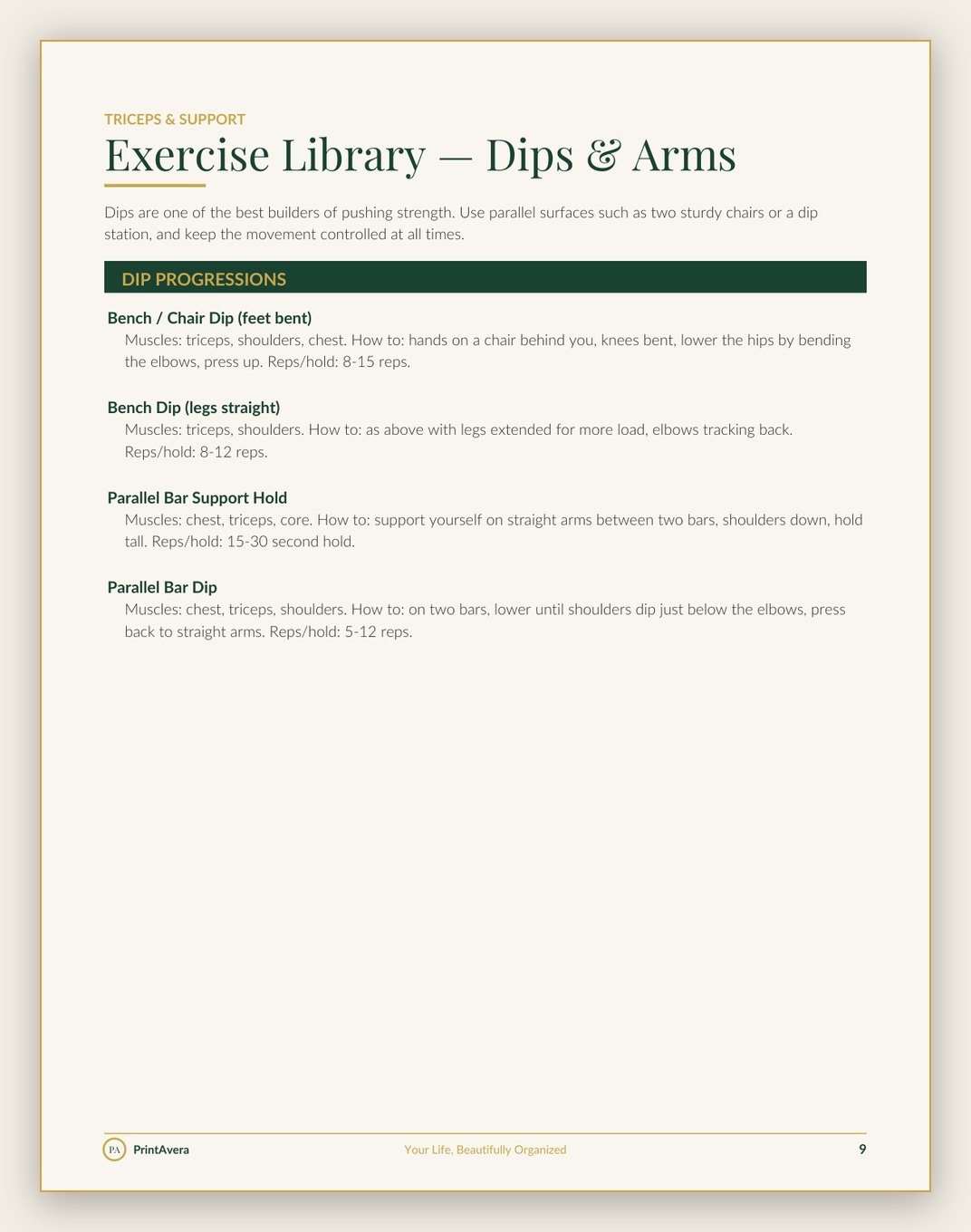
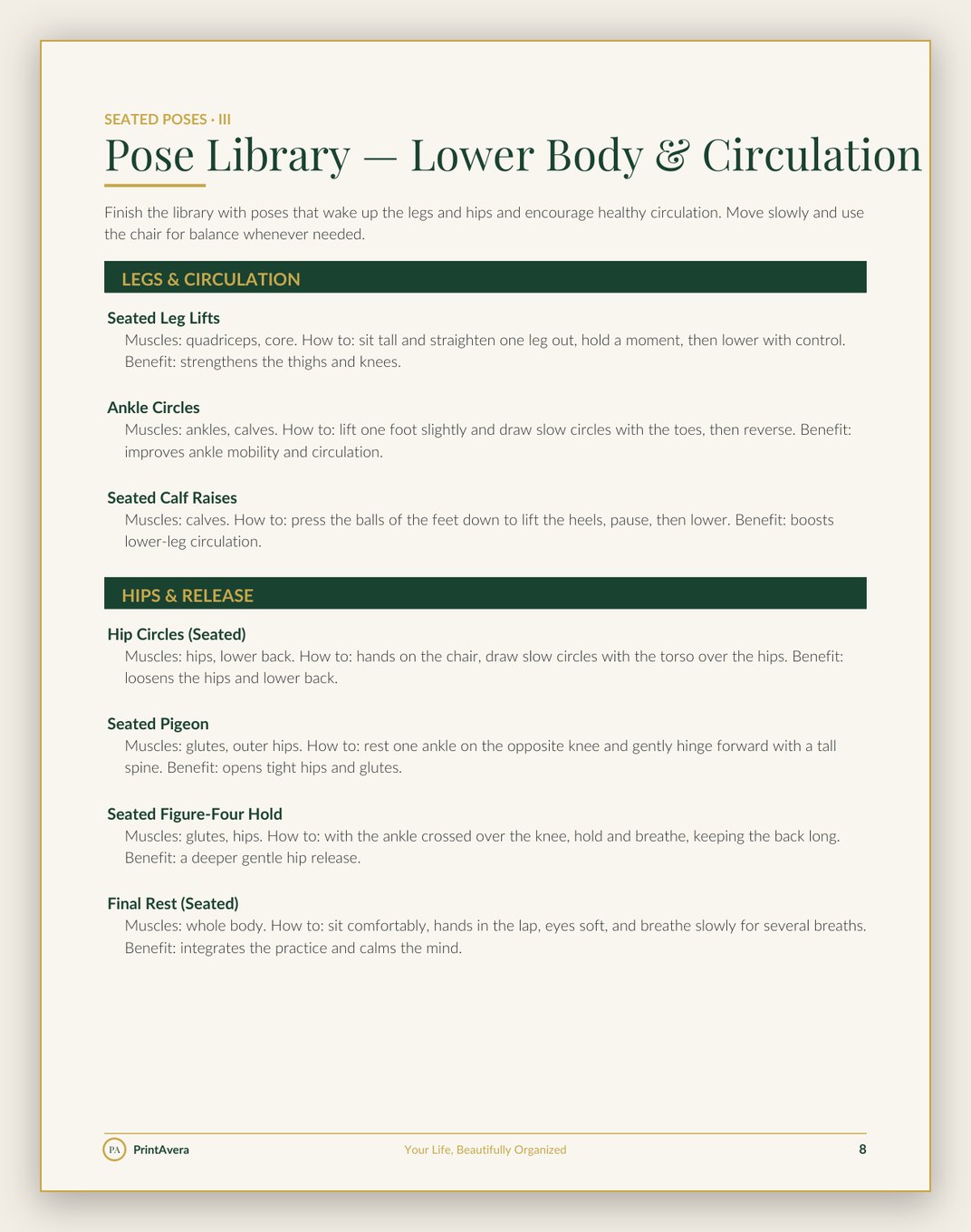
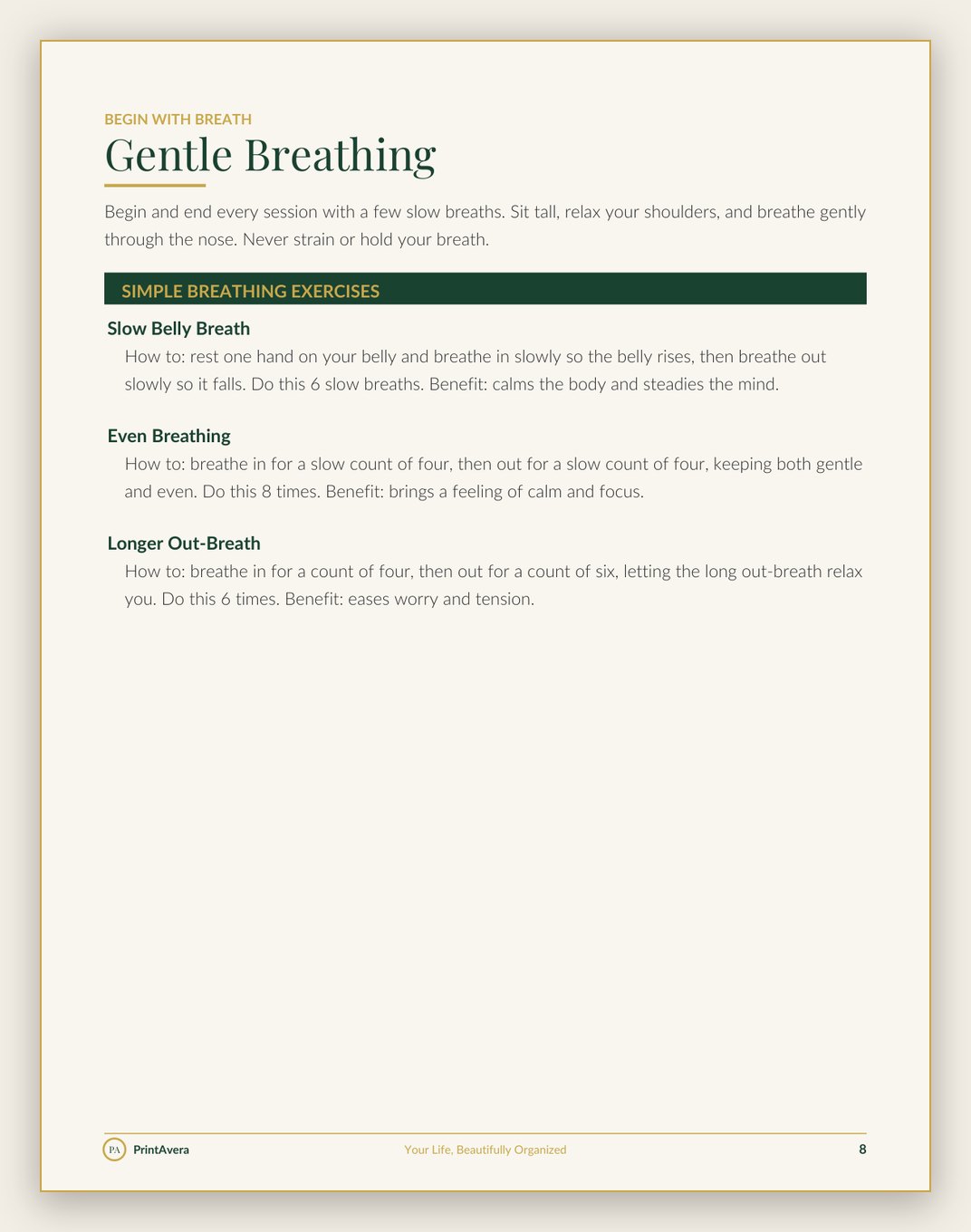
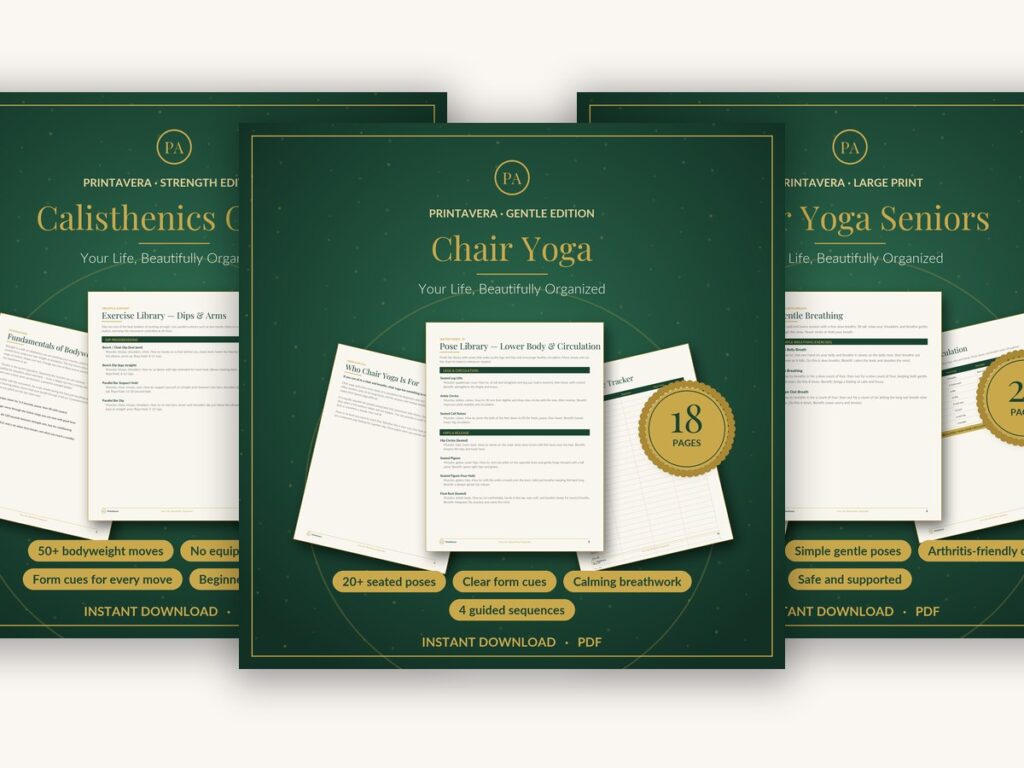
Real pages from this collection — every spread designed in our signature forest-green and gold style. See them all on Etsy →
Shop the Collection
Fitness & Movement
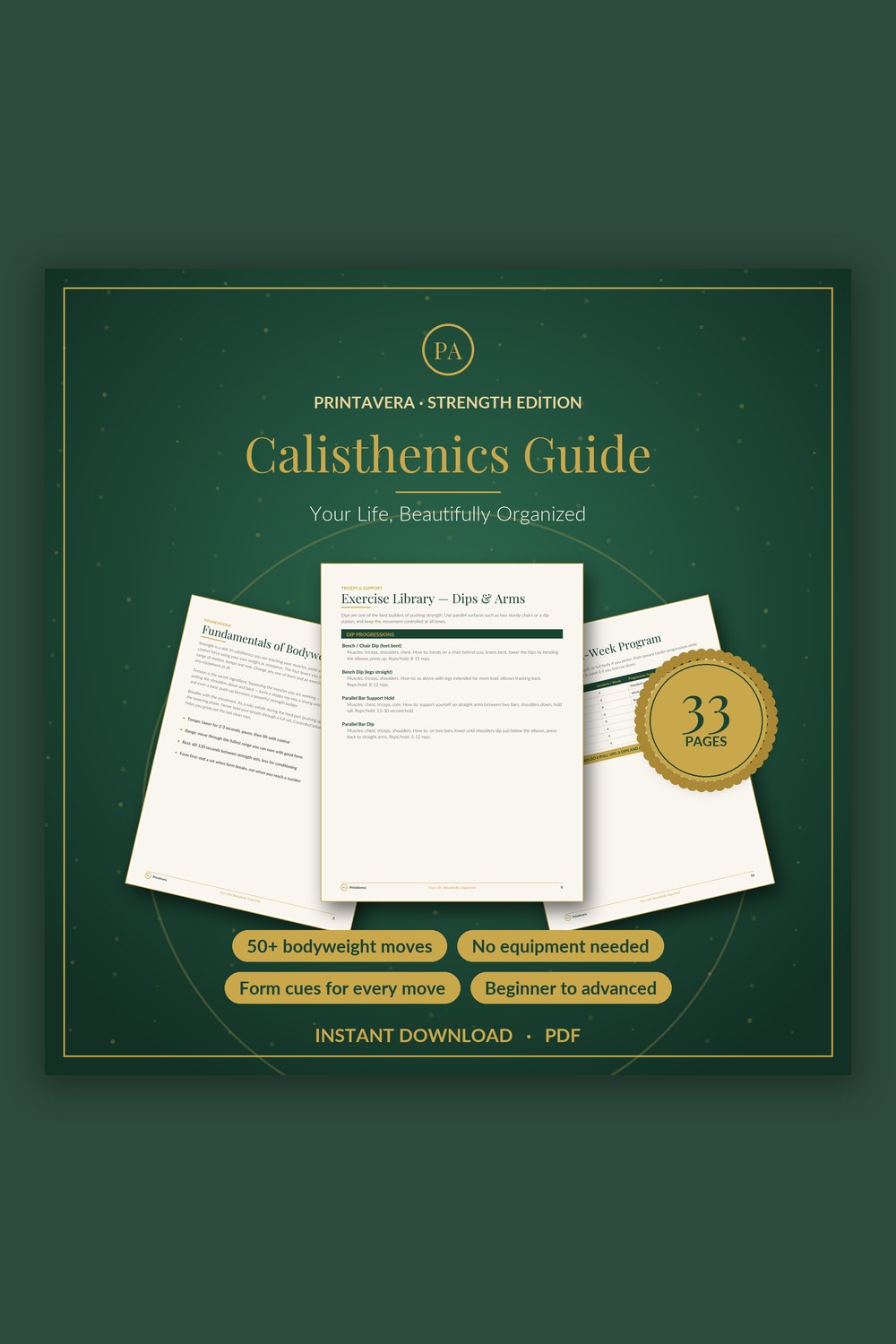
Calisthenics Workout Printable
Build real strength anywhere with no equipment — a complete bodyweight library of 50+ movements, structured beginner-to-advanced programs, and trackers that turn effort into visible progress.
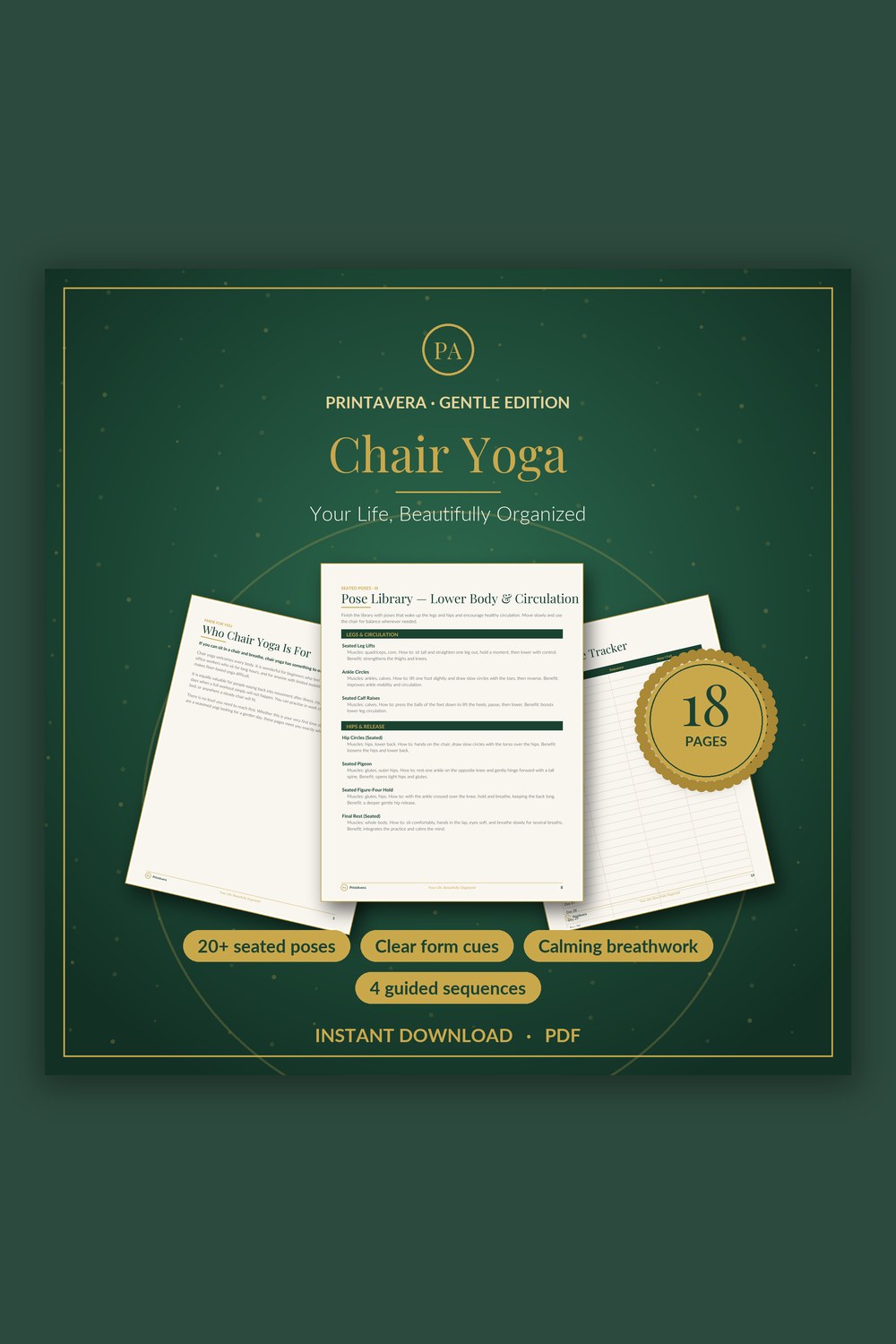
Chair Yoga Printable
Gentle, accessible yoga you can do from a chair — a library of 20+ supported poses with clear cues, guided sequences for morning, desk breaks and stress relief, and a tracker to keep you coming back.
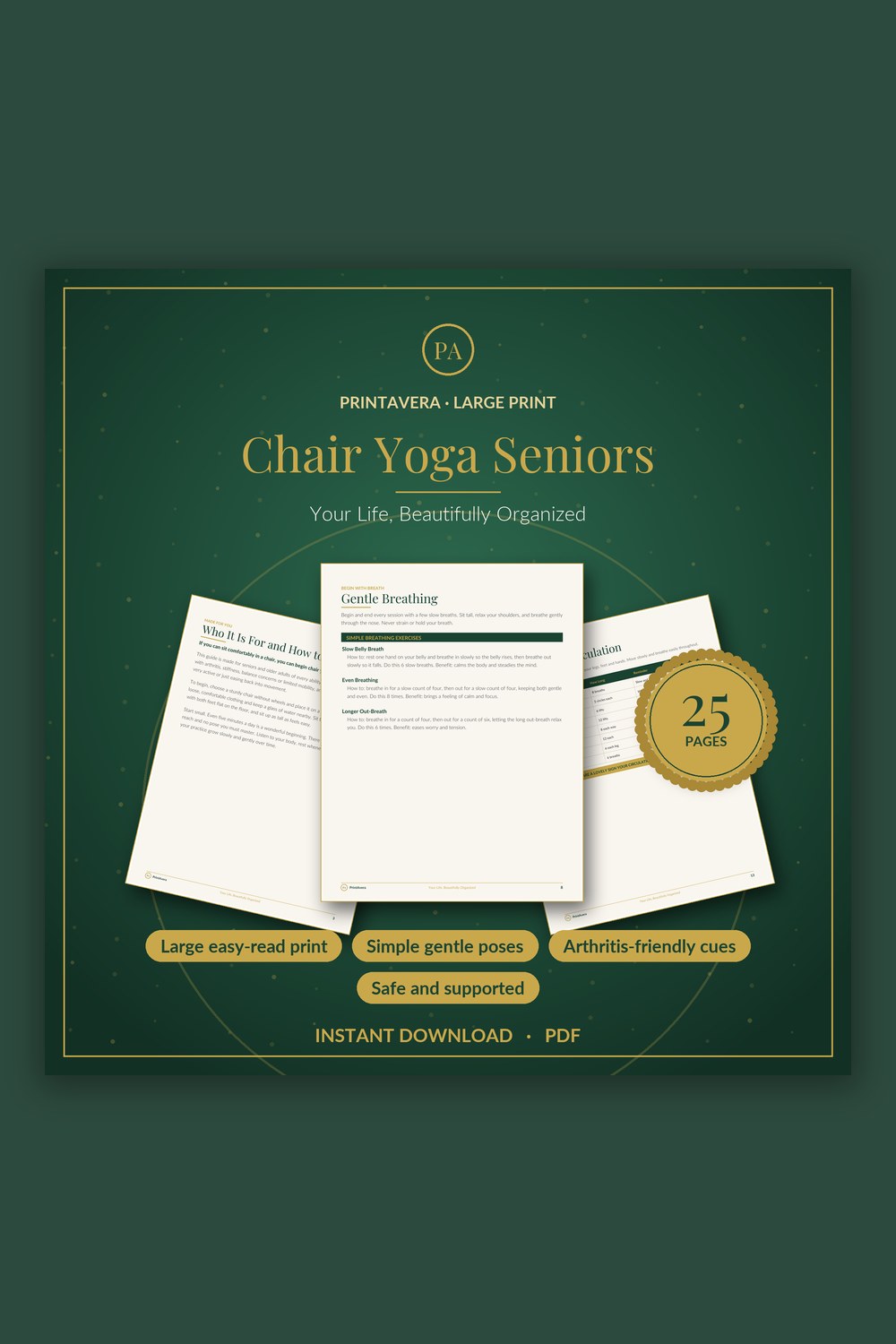
Chair Yoga for Seniors Printable
Gentle, safe seated yoga designed for seniors and printed in large, easy-to-read type — simple poses, arthritis-friendly modifications, and slow routines for balance, circulation and mobility.
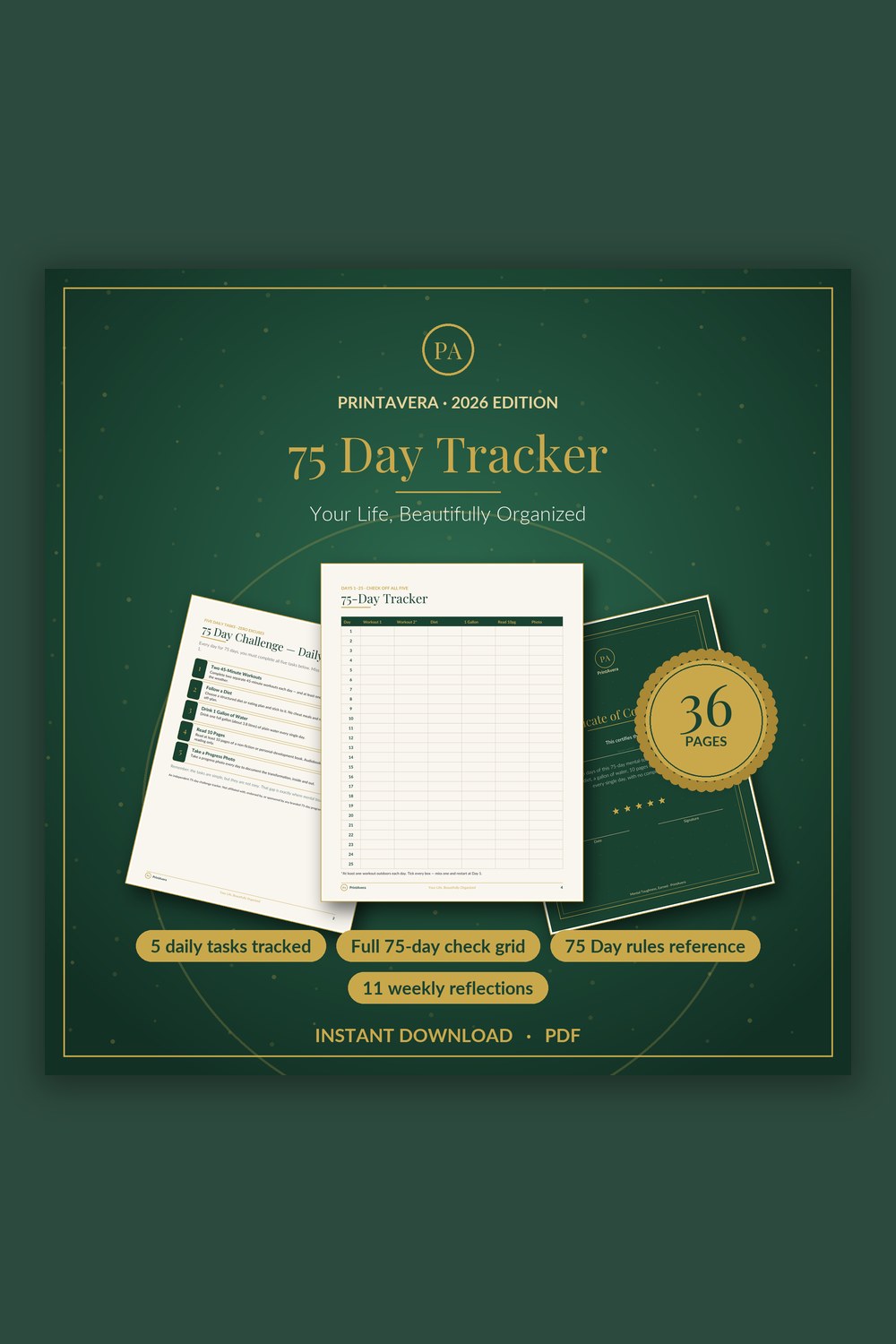
75 Day Challenge Tracker Printable
Conquer all 75 days with a premium, distraction-free tracker that keeps you honest on every single task.
Workout Log Printable
A complete workout log printable that turns every session into visible progress — log exercise, sets, reps and weight, then beat…
The Complete Guide
Starting Calisthenics Without a Gym or Fear
Calisthenics is a grand-sounding word for something refreshingly simple: training with your own bodyweight. No membership, no machines, barely any equipment, just a patch of floor and the willingness to begin where you actually are today. That accessibility is its quiet genius, because the biggest barrier to strength training has never really been ability; it has been the intimidation of equipment and the feeling of not belonging in a gym.
Strength is built by meeting your body where it is and nudging gently forward.
The whole art of starting well is choosing a version of each movement that matches your strength right now, and then progressing slowly as your body adapts. A push-up does not have to begin on the floor; it can begin standing, with your hands on a wall, then later on a sturdy counter, then on your knees, long before it ever happens flat on the ground. The same patience applies everywhere. Strength is built by meeting your body where it is and nudging gently forward, not by leaping to the hardest version and getting hurt or discouraged.
A balanced beginner routine needs surprisingly little: something that pushes, something that pulls or rows, a squat for the lower body, and a little core work. Master easy versions of those few foundations and you have covered most of what strength training is for. A calisthenics workout printable lays out a simple, repeatable plan with these movements and their gentler progressions, so your energy goes into moving rather than into wondering what on earth to do next.
- Begin with the easiest version of each move, such as wall or counter push-ups, and progress gradually.
- Focus on a few foundational movements: a push, a pull, a squat, and some core work.
- Prioritise good, controlled form over speed or high repetition counts.
- Rest between sessions so your body has time to recover, rebuild, and grow stronger.
How Progressions Keep You Moving Forward
The idea that quietly unlocks bodyweight training is the progression: the same movement offered along a ramp from very gentle to genuinely demanding, so there is always a step that fits you and always a next step waiting. This is what makes calisthenics so kind to beginners. You are never stuck choosing between an exercise that is impossibly hard and nothing at all; you simply slide along the ramp to the rung that challenges you a little without overwhelming you.
You are never stuck choosing between impossibly hard and nothing at all.
Knowing when to progress is mostly a matter of listening. When a movement starts to feel controlled and almost comfortable for your full set, when you finish and feel worked rather than wrecked, that is your body inviting you one small step further. There is no prize for rushing. Lingering on an easier version for an extra week or two builds a sturdier foundation and dramatically lowers your risk of the strain or soreness that derails so many promising starts.
Rest is part of the progression, not a break from it. Muscles grow stronger in the recovery between sessions, not during the effort itself, which is why beginners often do best with full rest days woven through the week. Be patient and generous with yourself: progress in movement is rarely a straight line, and the people who keep going are almost never the ones who pushed hardest, but the ones who stayed kind, consistent, and willing to take the next small step when their body was ready.
- Treat each exercise as a ramp, sliding to the version that challenges you without overwhelming you.
- Progress only when a movement feels controlled and you finish worked rather than wrecked.
- Linger on easier versions a little longer to build a sturdier, injury-resistant foundation.
- Weave in full rest days; strength is built during recovery, not only during effort.
Reader Favourite
Calisthenics Workout Printable
Build real strength anywhere with no equipment — a complete bodyweight library of 50+ movements, structured beginner-to-advanced programs, and trackers that turn effort into visible progress.
Gentle Chair Yoga for Every Body
Chair yoga takes the calm, the stretching, and the breath-focused ease of yoga and brings it all to a seated position, which quietly removes the single biggest barrier many people face: getting up and down from the floor and balancing once there. With a chair supporting you, your attention is free to rest on comfortable movement and steady breathing instead of on staying upright. It is a deeply kind practice, and a genuinely effective one.
Let comfort, not achievement, be the measure of a good session.
It is especially welcoming for seniors, for anyone with limited mobility, for those recovering from injury or illness, and for people who simply want a softer way to move during a long or stressful day. A short seated routine can ease stiffness, coax in deeper breathing, gently encourage circulation, and offer a quiet pocket of self-care that asks nothing dramatic of you. None of it requires flexibility to begin; the flexibility, in its own modest way, tends to follow.
The guiding principle is gentleness. Move slowly, only as far as feels genuinely comfortable, and let your breath set the pace rather than forcing any stretch toward a goal. A chair yoga printable, including versions thoughtfully designed for seniors, offers simple sequences you can follow without memorising a thing, so you can relax into the practice instead of trying to remember what comes next. Use a sturdy, stable chair, and let comfort, not achievement, be the measure of a good session.
- Use a sturdy, stable chair without wheels, placed on a non-slip surface.
- Move gently within a comfortable range and never force or push into a stretch.
- Let slow, steady breathing set the pace of every movement.
- Stop and rest if anything feels painful rather than pleasantly stretchy.
Surviving and Enjoying a Multi-Day Challenge
A longer challenge can be a wonderful framework, because it trades the vague intention to move more for something concrete: a clear structure, a defined finish line, and the genuinely satisfying feeling of days stacking up behind you. That visible momentum is motivating in a way that open-ended goals rarely are. The catch, and it is an important one, is that the challenge has to fit your real life, or it flips from encouraging to crushing almost overnight.
Before you commit, look honestly at what a given challenge asks of you and whether you can meet it most days without wrecking the rest of your life. It is far better to choose a gentler version you can genuinely complete than an extreme one that leaves you feeling like a failure by day four. The whole value of a challenge is the confidence of finishing something you started, and that confidence is built by setting yourself up to succeed, not by proving how much you can endure.
Once you begin, make your progress visible, because seeing a row of completed days is quietly powerful on the mornings motivation has gone missing. And when you miss a day, and at some point you almost certainly will, simply continue rather than starting over emotionally or declaring the whole thing ruined. A 75 day challenge tracker printable gives you a place to mark each day, watch your streak grow, and celebrate the small wins, all while reminding you that a lasting habit is built one ordinary, unglamorous day at a time.
- Choose a challenge version that genuinely fits your life rather than the most extreme option.
- Make your progress visible so a growing row of completed days carries you on low days.
- If you miss a day, continue rather than starting over or abandoning the whole effort.
- Celebrate small wins along the way; finishing something you started builds real confidence.
Find your perfect Fitness & Movement printable
Each design is an instant digital download — buy it, download it, and start today. Print at home or use it on any tablet.
Building a Movement Habit That Outlasts Motivation
Here is the quiet truth underneath every fitness plan: consistency, not intensity, is what actually changes things. A gentle routine you keep for a year will do far more for you than a punishing one you abandon in a fortnight. Motivation, meanwhile, is a fair-weather friend; it shows up on the easy days and vanishes on the hard ones, which is precisely why a lasting habit can never be built on motivation alone. It has to be built on something steadier.
Movement is not a test you can fail; it is a form of care you offer your body.
That steadier thing is usually a system. Attach movement to something you already do, so it stops depending on how you feel; stretch in the chair while your coffee brews, do your few calisthenics sets right after you brush your teeth, mark your tracker the moment you finish. Keep your starting commitment almost embarrassingly small, because a habit you never skip because it is too easy will quietly outgrow itself, while an ambitious one you dread will not survive a single bad week.
Above all, be generous with yourself. Movement is not a test you can fail or a debt you owe your body; it is a form of care you offer it. There will be missed days and slow weeks, and they mean nothing except that you are a human living a real life. Just keep gently returning. A 75 day challenge tracker or a simple workout printable can hold the structure for you, but the real practice is far simpler than any plan: show up, kindly, more often than not, for as long as you can, in whatever way your body allows today.
- Lean on consistency over intensity; a gentle routine you keep beats a punishing one you drop.
- Anchor movement to existing daily habits so it no longer depends on motivation.
- Keep your starting commitment small enough that you never skip it because it feels too hard.
- Treat missed days as ordinary and simply return, kindly, more often than not.
Frequently Asked Questions
Do I need any equipment or experience to begin?
Not much at all, which is part of the appeal. Calisthenics relies on your own bodyweight, and chair yoga only asks for a sturdy chair, so both are genuinely friendly to complete beginners. Start with the gentlest version of each movement and build up slowly as you feel ready, with no pressure to look a certain way or keep up with anyone. The only real requirement is a little space and the willingness to begin where you are today.
Is chair yoga suitable for seniors or people with limited mobility?
Yes, and it is one of chair yoga's greatest strengths. The chair provides steady support and removes the balance and floor-transition challenges of standing poses, which makes it accessible for many seniors and people with limited mobility. Versions designed specifically for seniors keep the movements especially gentle and approachable. As always, check with your doctor first, use a stable chair, and move only within a range that feels genuinely comfortable for your body.
How do the printables work once I purchase them?
They are usually instant digital downloads, so you can access and print them right after buying, with nothing to wait for in the mail. Many people print a copy to keep nearby, perhaps on a fridge or in a folder, and save the original file to reprint a fresh page whenever they need one. You can follow them at home, at your own pace, on your own schedule, with no special equipment beyond an ordinary printer. They are yours to reuse as often as you like.
I am completely out of shape. Is calisthenics really for me?
It genuinely is, because the whole approach is built around progressions that meet you exactly where you are. Every movement has a gentle starting version, like a push-up against a wall, so you are never asked to do something beyond your current strength. You begin at the rung that fits you and move forward one small, comfortable step at a time. Being out of shape is not a reason to stay out; it is simply the place you start from, and starting is the only requirement.
What if I miss a day during a longer challenge?
Missing a day is completely normal and absolutely not a reason to give up. The goal is overall consistency across the whole challenge, so the kindest and most effective response is to simply pick up where you left off rather than feeling you have failed or starting the count over emotionally. A tracker helps a great deal here, because it shows how much you have already accomplished, which is usually far more encouraging than fixating on a single missed day. One gap does not undo your progress.
Should I check with my doctor before starting?
It is a genuinely good idea, especially if you have a health condition, an injury, are pregnant, or have been inactive for a while. A short conversation with your doctor can help you start safely and adapt any movement to your particular needs, and it costs you nothing but a little time. These printables are encouraging, friendly guides, not medical advice, so let your provider help you tailor them to you. Starting safely is part of starting well.
How do I stay consistent when my motivation disappears?
The honest answer is to stop relying on motivation, because it will always come and go. Instead, lean on structure: keep your commitment small enough that you can do it on a bad day, and anchor it to something you already do, like stretching while the kettle boils. Make your progress visible with a tracker so the momentum itself carries you, and be gentle with the inevitable missed days. Consistency is built by returning kindly, more often than not, not by feeling motivated every single time.
Why PrintAvera?
Every PrintAvera design is created in-house to a five-star standard — considered layouts, calm forest-green and gold styling, and typography chosen to make every page feel intentional. Each one is an instant digital download you can print at home or use on any tablet in minutes. Beautiful enough that you will actually want to use it, every single day.
Explore More Collections